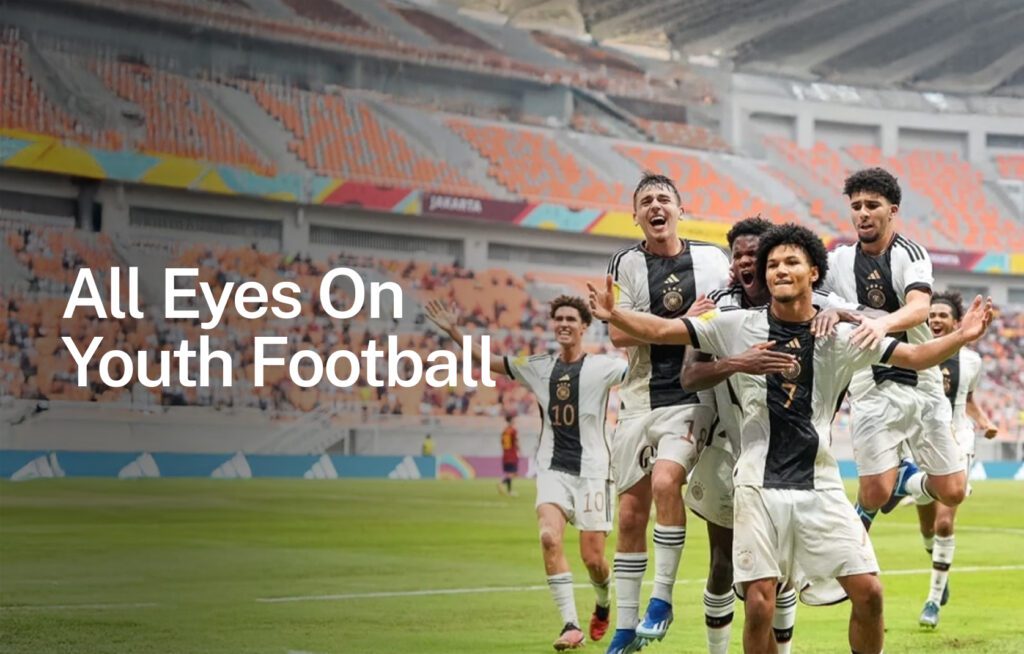


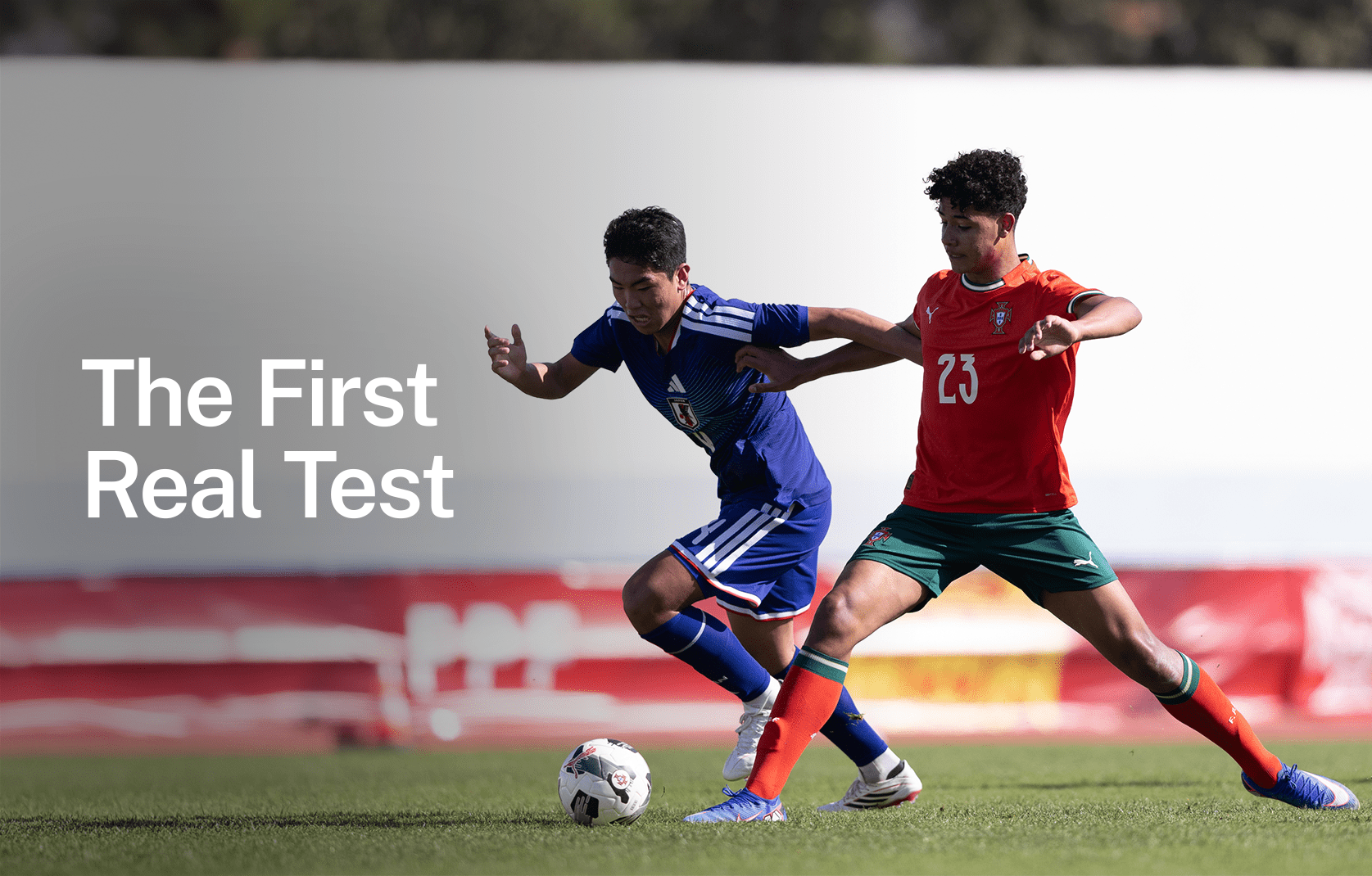
The Mondial Montaigu has been running in France since 1973, quietly building a reputation as one of the most reliable early indicators of international youth talent.
It focuses on U16 national teams, which places it in a very specific — and useful — phase of development. Players are far enough along to show clear traits, but still early enough that those traits haven’t been smoothed out or masked by physical maturity, tactical systems, or professional environments.
For scouts, that timing is the value. They’re not watching finished profiles. They’re watching players before the game has fully shaped them.
Why U16 International Football Is So Revealing
At club level, even young players operate inside structure. Movements are rehearsed, relationships are built over months, and roles are reinforced week after week.
Montaigu removes most of that. Players arrive with limited preparation time, often having trained together for just a few days, and are expected to compete immediately against other top national prospects facing the same constraints.
The result is a different kind of football. Less coordinated, more transitional, and far less forgiving. Decisions have to be made without the usual reference points, and players are forced to rely on their own perception, timing, and problem-solving.
That is precisely why the tournament is useful. It exposes what belongs to the player, not just what belongs to the system around them.
What the Tournament’s History Actually Shows
It’s often noted that players like Paul Pogba, Phil Foden, and Jamal Musiala all passed through Montaigu.
That fact is usually presented as proof that the tournament identifies future stars. In reality, it says something more nuanced.
Montaigu doesn’t predict careers. What it does — consistently — is surface traits early, in an environment where those traits are harder to hide. The underlying behaviors that tend to scale as a prospect’s career advances.
Club Form and International Translation
One of the easiest mistakes to make at youth level is to overvalue performance in isolation. A player who dominates at Montaigu can look decisive simply because the game is more open, more transitional, and less structured than what they face at club level.
At the same time, players who rely on coordinated patterns — positional rotations, structured build-up, rehearsed pressing — can look less effective in this setting, not because they lack quality, but because the environment doesn’t support their strengths.
So the evaluation shifts away from output and toward translation. The question is no longer who performed, but what remains consistent when the environment changes.
Does the player scan before receiving, regardless of context? Do their decisions hold under increased pressure? Do their technical actions stay stable as the tempo rises?
These are the elements that carry beyond a single tournament.
Why Live Viewing Isn’t Enough
Watching matches live gives you access, but it rarely gives you clarity. The speed of the game forces you to react to outcomes (a successful dribble, a misplaced pass, a defensive mistake) while the actions that lead to those moments often pass unnoticed.
The details that matter tend to sit just before the obvious ones: the body orientation before receiving, the timing of a supporting run, the small defensive adjustment that prevents danger before it develops.
These are not easy to capture in real time. They require distance, repetition, and comparison across multiple sequences.
That’s why serious evaluation happens after the match. You go back, slow the game down, and test whether your initial impressions actually hold when you remove the noise.
Building a Full Picture Around Montaigu
A tournament like Montaigu offers a limited sample. Most players will only have four to five matches across the tournament. Enough to form an impression, but not enough to support a decision on its own.
To make it meaningful, you need to place it inside a broader context.
Before the tournament, you look at the player in their club environment — their role, their habits, the actions they repeat over time. During the competition, you observe how those traits translate under different demands. And afterwards, you revisit both, checking whether what stood out was consistent or simply situational.
That process — before, during, after — is what turns exposure into understanding.
Montaigu 2026 on Eyeball
For the third consecutive year, every match from the 2026 edition of Montaigu will be available on Eyeball.
The value isn’t just in being able to watch the tournament. It’s in being able to connect it to everything around it — the club matches that came before, and the analysis that follows after.
Instead of relying on isolated impressions, you can track players across environments, compare performances over time, and build a view that holds beyond a single week of football.
Players to Watch and How to Track Them
Our team has already identified a group of players worth following closely at this year’s tournament.
If you want access to that list, and a structured way to follow those players before, during, and after Montaigu, get in touch.
We’ll help you approach the tournament with a clear framework. Not just a shortlist of names.